How much should you actually tip on a $60 bill?
What 15%, 18%, 20%, and 25% come out to on a $60 check, split evenly, and why the "always 20%" rule is newer than it feels.
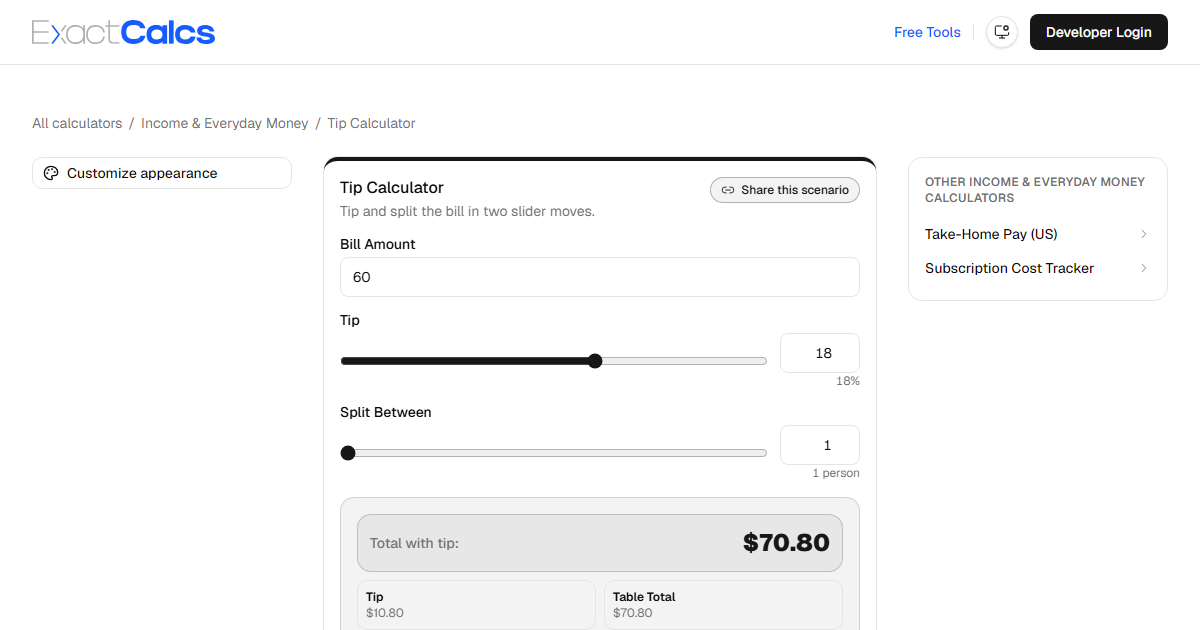
On a $60 bill: 15% is $9.00 (total $69.00), 18% is $10.80 (total $70.80), 20% is $12.00 (total $72.00), and 25% is $15.00 (total $75.00). Split four ways at 20%, that's $18.00 per person.
Why "always 20%" is a newer norm than it feels
US tipping norms have moved from a 15% baseline (common through the 1990s–2000s) toward 18–20% as a default expectation at full-service restaurants, driven partly by point-of-sale systems suggesting 18/20/25% preset buttons instead of a blank tip line. 20% isn't a fixed rule — it's closer to the current upper-typical range for good service, with 15% still standard for adequate-but-unremarkable service in most of the US outside major coastal cities.
The full breakdown on $60
- 10% (counter service / bare minimum): $6.00 — total $66.00
- 15%: $9.00 — total $69.00
- 18%: $10.80 — total $70.80
- 20%: $12.00 — total $72.00
- 22%: $13.20 — total $73.20
- 25%: $15.00 — total $75.00
Tip on the pre-tax or post-tax amount?
Tipping etiquette generally recommends calculating the tip on the pre-tax subtotal, not the total after sales tax — tax isn't part of what the server actually earned for the meal. The gap is usually small (a few percentage points of sales tax translate to cents on a $60 bill) but it's the technically correct base.
Splitting the bill
For an even split, divide the post-tip total by the number of people; for an uneven split (different orders), tip each person's own subtotal separately and sum. ExactCalcs' tip calculator handles both, plus custom tip percentages and any number of people.