Solar panel payback period: how many years until they pay for themselves?
The payback-period math behind a solar quote, and the three inputs that move it more than panel efficiency does.
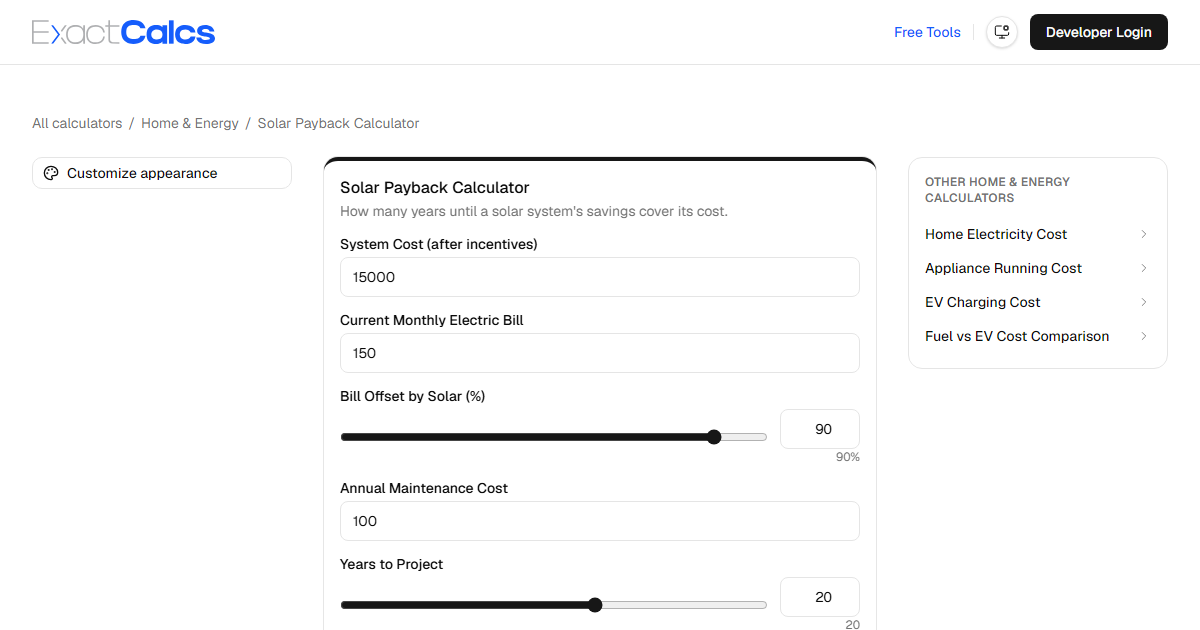
A typical residential solar installation — after the 30% US federal tax credit — pays for itself in roughly 7 to 10 years, with panels usually warrantied for 25. That leaves 15+ years of essentially free electricity after payback, which is the actual return on the investment, not the payback period itself.
The three inputs that move payback more than panel efficiency
- Local electricity rate. Payback is fastest where grid electricity is expensive (California, Hawaii, the Northeast) and slowest where it's cheap (parts of the Pacific Northwest, the South) — a 2x difference in rate roughly halves or doubles payback time for an identical system.
- Net metering policy. Full retail-rate net metering (exporting excess power back to the grid at the same rate it's bought) makes payback meaningfully faster than a state with reduced export credit or none at all.
- Incentives and tax credits. The 30% federal credit alone cuts payback time by roughly 30%; state and utility rebates stack on top where available.
Panel efficiency differences between competing residential panels (roughly 18–23%) move the payback number by a much smaller margin than any of the three above.
The payback formula
Payback period (years) = net system cost (after incentives) ÷ annual electricity savings. Annual savings depends on system size, local sun hours, and the electricity rate being offset — which is why two identical systems in different states can have payback periods years apart.
Run the numbers for a real quote
Plug in system cost, expected annual production, and local electricity rate into the solar payback calculator to get a payback year specific to an actual quote, rather than a national average that may not apply.