Rent vs. buy: how many years until buying actually wins?
The break-even year where a home purchase beats renting, and the assumptions that move it by years in either direction.
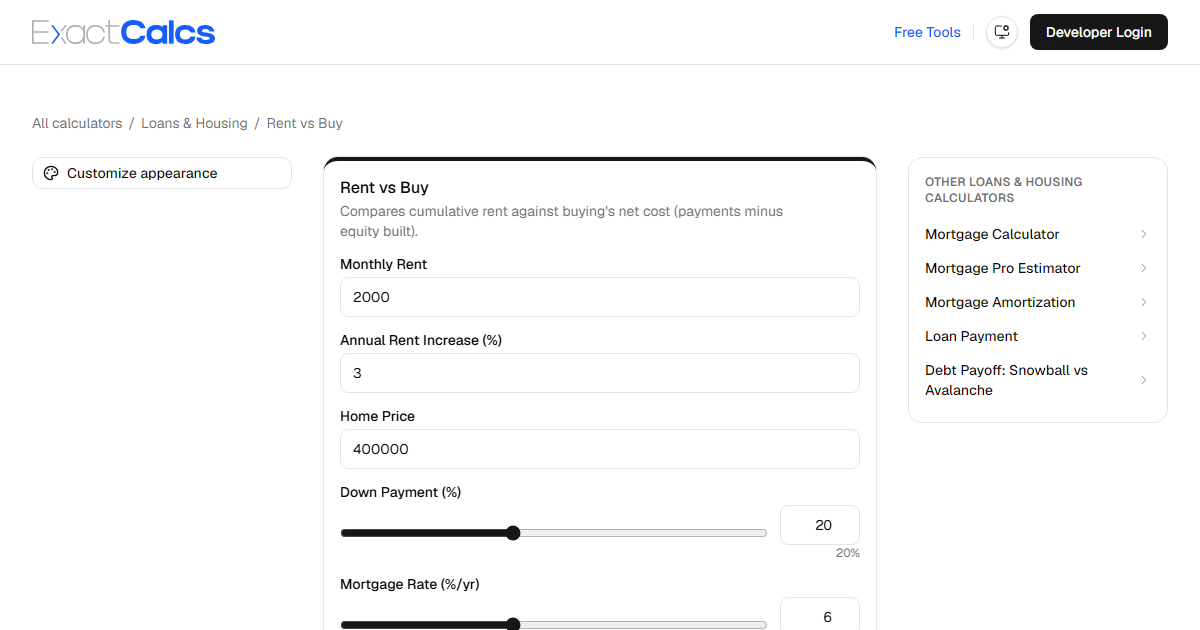
For a typical US market with a 20% down payment and moderate home-price appreciation, the break-even point where buying beats renting lands around 5 to 7 years of staying in the home — closing costs, transaction fees on eventual resale, and the opportunity cost of the down payment all have to be recovered before buying pulls ahead financially.
Why "buying is always better long-term" isn't automatically true
Buying carries upfront costs (closing costs, typically 2–5% of the loan) and ongoing costs renting doesn't (property tax, maintenance, insurance, HOA) that renting's monthly payment already bundles into the landlord's price. The down payment also has an opportunity cost — money that could otherwise be invested. Buying wins once enough years of building equity and avoiding rent increases outweigh those costs; the break-even year is exactly the point where that flips.
The inputs that move the break-even year most
- Expected years in the home — the whole calculation only matters relative to how long you'll actually stay.
- Home price appreciation rate — a market appreciating 2%/year vs. 5%/year shifts break-even by multiple years.
- Rent growth rate — markets with fast rent inflation make buying's fixed(-ish) payment look better sooner.
- Investment return on the down payment if not spent — a real opportunity cost, not a rounding error.
Run the actual comparison
The rent vs. buy calculator takes a real purchase price, rent, down payment, mortgage rate, and expected years in the home, and returns the actual break-even year and net cost difference for that specific scenario — not a national average that may not match a given city's numbers.