How much extra should you pay on your mortgage to pay it off a year early?
The extra monthly amount that shaves a year off a mortgage, with real numbers at 6.5% and 30 years.
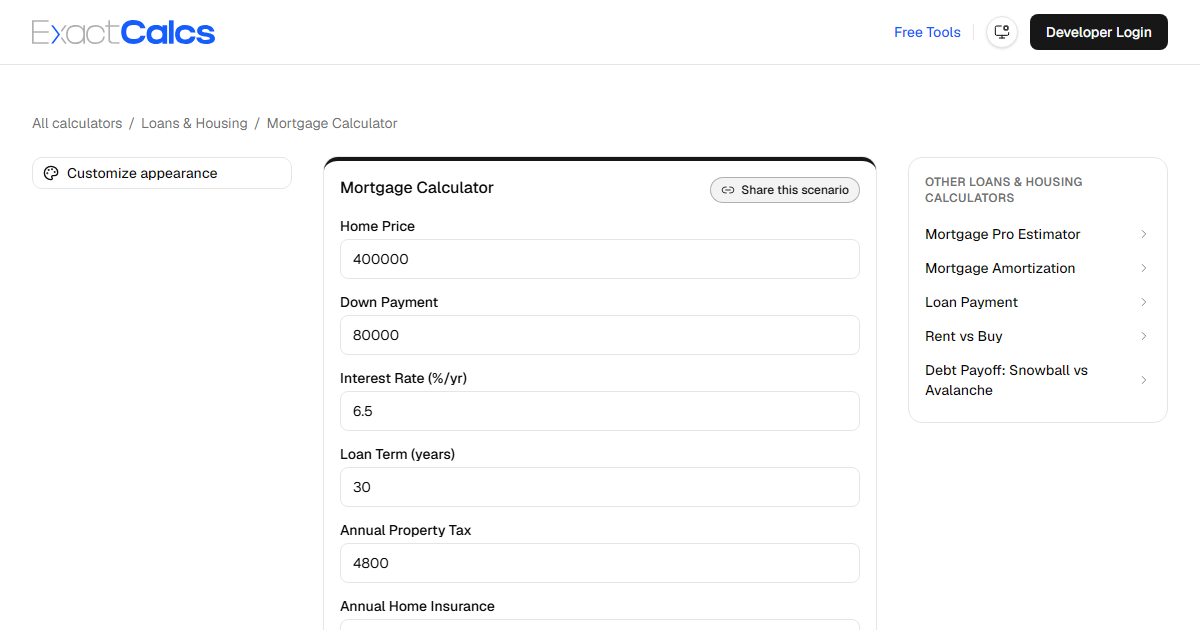
On a $400,000, 30-year mortgage at 6.5%, an extra $285/month toward principal pays it off about a year early and saves roughly $14,700 in interest. Because 30-year mortgages front-load interest so heavily, even a modest extra payment removes a disproportionate number of months from the back of the schedule.
Why early-loan extra payments punch above their weight
In the first years of a 30-year mortgage, most of the payment is interest — on a $400,000 loan at 6.5%, the very first payment is over $2,100 in interest against roughly $430 in principal. Every extra dollar of principal paid early removes that dollar from every future month's interest calculation for the remaining 29+ years, which is why early extra payments save far more than the same dollar amount paid in year 25.
Worked example: $400,000 at 6.5%, 30 years
- Standard monthly payment (principal + interest): $2,528
- Total interest over 30 years: $509,900
- With +$285/month from payment 1: payoff in ~29 years, total interest ~$495,200
- Interest saved: ~$14,700; time saved: ~12 months
Small percentage differences in the extra amount move these numbers a lot — doubling the extra payment to $570/month cuts closer to 4 years and $50,000+ in interest, not just twice the single-payment result, because of the same compounding effect.
Before committing extra cash to principal
Extra principal payments are a guaranteed return equal to the mortgage rate — worth comparing against other uses of that cash (higher-interest debt, retirement account matching, an underfunded emergency fund) rather than assuming paydown is automatically the best use of an extra $285/month.